| |
| Making tends to happen in concentrated bursts when a firing or exhibition is on the horizon! |
| I have found that raw glazing gives a rhythm to the making that I enjoy. It enables me to see through the process of creating a batch of pots from raw clay to kiln-ready without interruption, and gives more variety to the workshop routine. I don't think I have had more seconds than I had before and some things are easier - overglaze decoration, for example, and touching up whilst the glaze is still wet. |
| |
| Firing |
| |
| The 60 cu ft oil kiln was built in 1980 to the old COSIRA design with Swirlamiser burners and was my sole means of production for 19 years. |
| |
 |
| |
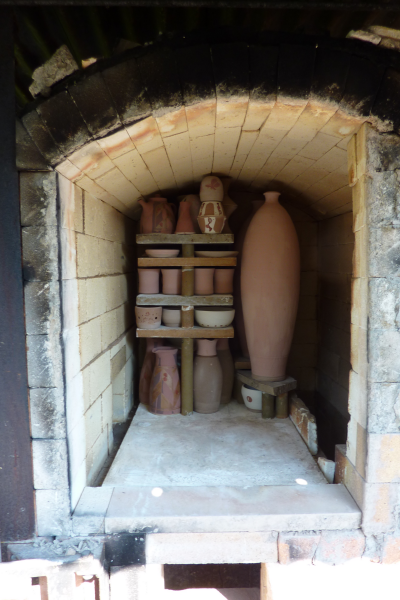
| The 18 cu ft wood kiln (above) was built in 1999 to the Paul Stubbs/Micki Schloessingk design, first launched at the International Potters' Camp at Aberystwyth. It has a very large firebox, with a layer of hemitubes which make it possible to control the level of ash and embers by opening a mousehole at floor level. It also has a Paul Stubbs engineered door, which saves the potter from heat exhaustion whilst stoking in the 1200's! It is a very potter friendly kiln, with bags of power, easy to fire on one's own. It even reduces well! |
| |
| I continued to fire the oil kiln from time to time until 2021, but then decided to wean myself off fossil fuels completely and work out ways of producing everything in the wood kiln. |
| |
|
| |
